
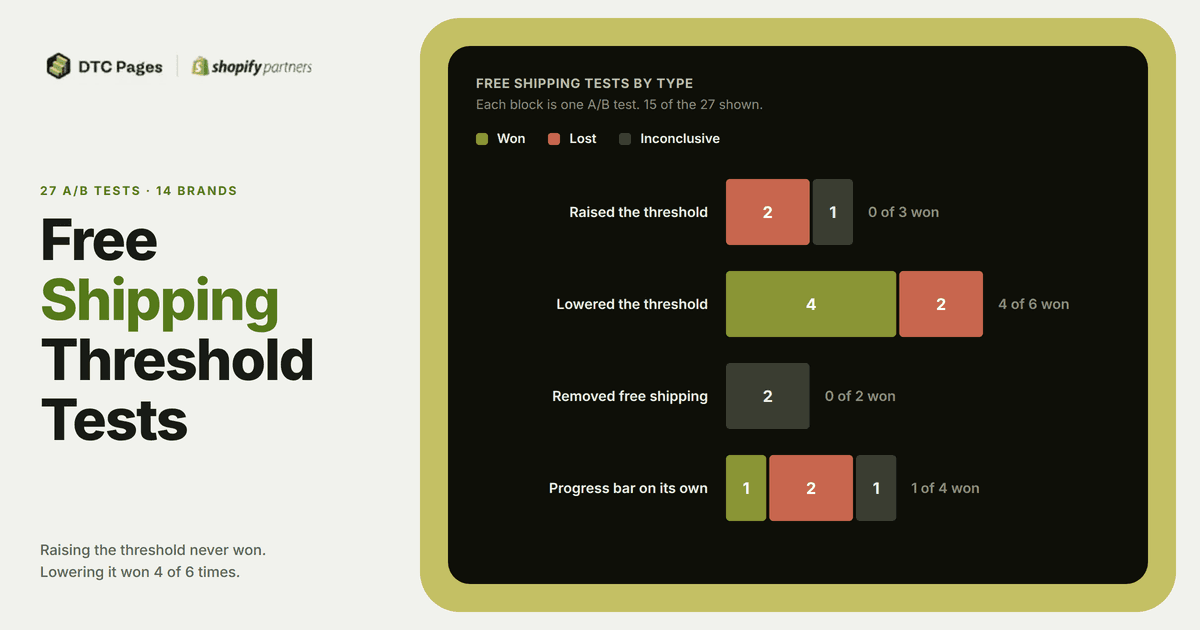
Many brands ask us what their free shipping threshold should be based on their AOV, or whether they should raise it, lower it or leave it alone. Most of the time our answer is "let's test it." We can't know in advance which threshold will perform best for a specific store, but the tests we have run show a pattern, and that is what this post is about.
Of the more than 1,300 tests we have run over the last five years, 27 were about free shipping, across 14 Shopify brands. Only 7 of them won, about one in four, against a 38% win rate across all our tests. And none of the tests that raised the threshold won.
According to Baymard Institute, the average cart abandonment rate is about 70%. Among shoppers who abandoned for a reason other than just browsing, 40% said extra costs such as shipping, taxes and fees were too high.
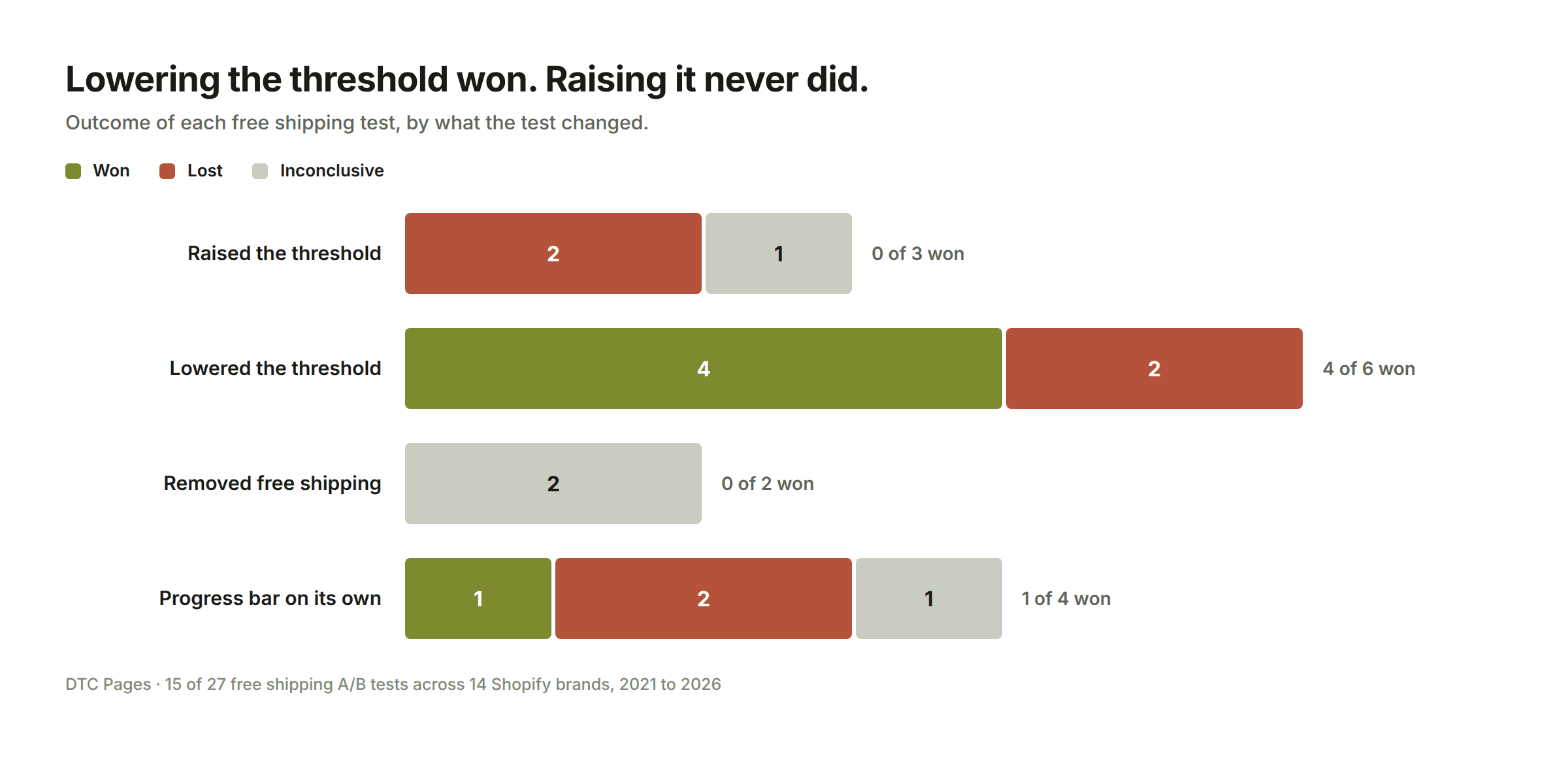
The usual advice is to set the threshold above your average order value so it pulls carts up. Our data points the other way: 4 of the 6 tests that lowered the threshold won, while none of the 3 that raised it did.
Key numbers at a glance#
| Metric | Value |
|---|---|
| Free shipping tests | 27, across 14 brands, 2021 to 2026 |
| Won | 7 of 27, against 38% across our full database |
| Tests that raised the threshold | 3, none won |
| Tests that lowered the threshold | 6, 4 won |
| Progress bars tested on their own | 4, 1 won |
27 free shipping A/B tests run by DTC Pages for 14 Shopify brands, 2021 to 2026.
How we collected this#
These tests come from the experiment logs we keep for every client, covering 2021 to 2026. A test counts if it reached a final result: a winner, a loser or inconclusive. Ideas, tests that are still running and changes that went live without a test are left out.
We call a winner when the variant has at least a 90% probability of beating the control on conversion rate, average order value, revenue per visitor or profit per visitor.
To keep our clients anonymous, we refer to brands by category and don't share their exact thresholds. When a threshold matters, we describe it relative to that store's average order value.
Do free shipping tests win as often as other tests?#
No. Only 7 of the 27 won, about 1 in 4, against 38% across every test in our database. Of those 27 tests, 16 changed the threshold or the shipping policy, and only 4 of them won. The other 11 changed only how free shipping was presented, such as progress bars, badges and cart copy, and those won 3 times.
27 tests is not a large enough sample to call it settled, but it points the same way as the rest of this post: free shipping changes win less often than most of what we test.
What happens when you raise the threshold?#
At least in our tests, nothing good. Three tests raised the threshold, and none won.
One luggage brand raised its threshold by half, and revenue per visitor fell about 16%. Conversion fell as well. The new threshold was still well below what most of its customers spent, so the loss was not about putting free shipping out of reach.
A sleep products brand raised its threshold twice, by small amounts, and neither version beat the original.
Some testing tool vendors have published cases where raising the threshold lifted revenue. We don't doubt those cases exist, but in our data the bigger orders did not make up for the shoppers who dropped out.
When does lowering the threshold pay off?#
Six tests lowered the threshold, and four won. The most useful pair comes from a single premium footwear brand.
In March 2026 the brand cut its threshold by 10%, and conversion fell about 10%. Two weeks later it tested a deeper cut, to a little below its average order value, and conversion rose about 7%, on more than 360,000 visitors.
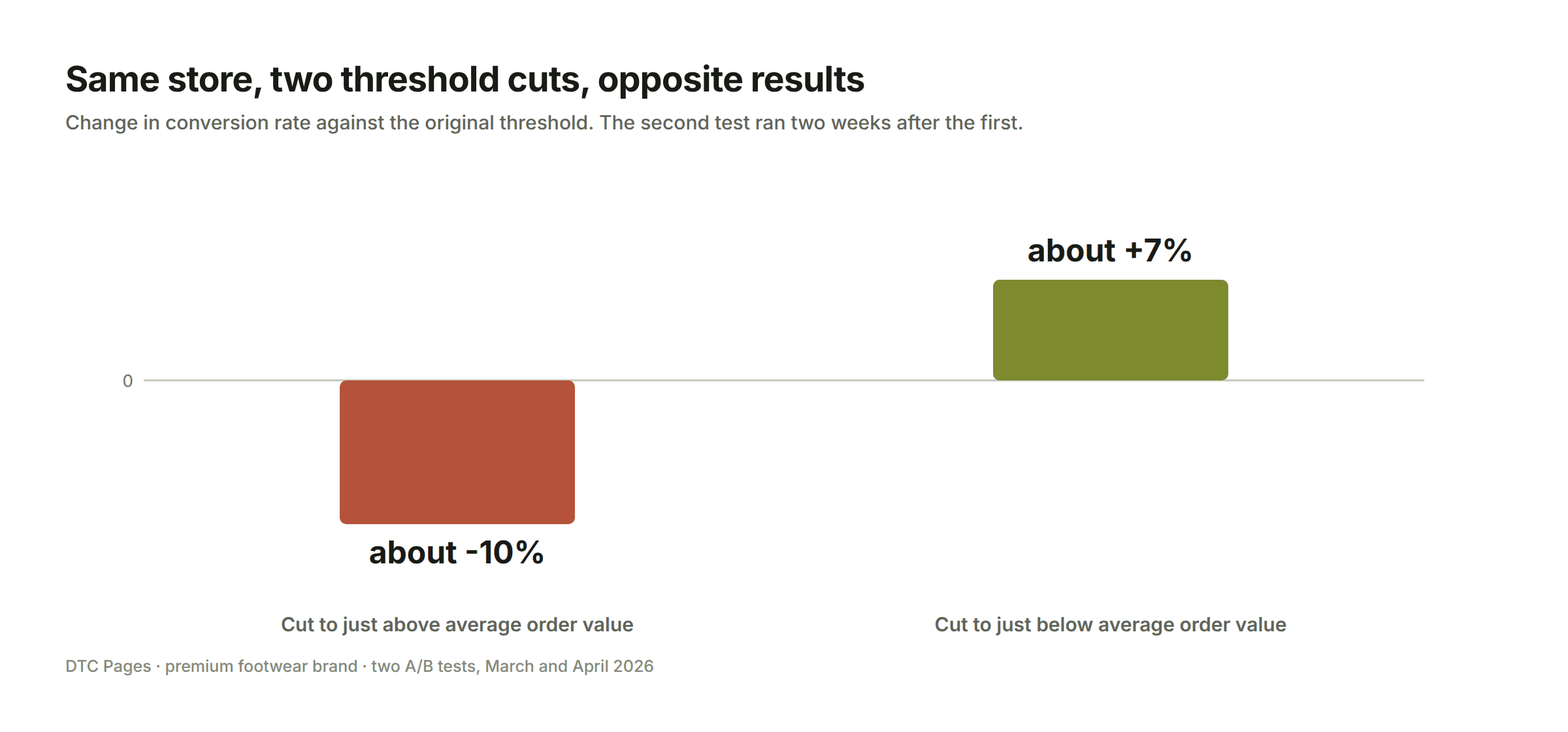
The difference between the two numbers is what a shopper had to put in the cart. At the deeper cut, a single pair from its most common price tier qualified on its own. At the smaller cut, the same shopper still needed to add an accessory. A household products brand shows the same pattern: its winning threshold was the first one a core product plus one add-on could reach.
Cutting much further does not help. A home decor brand cut its threshold to well below its average order value, and order value fell about 10%, because it was now giving free shipping to carts that had been paying for it.
What happens when you remove free shipping or raise the fee?#
Removing free shipping cost less than expected. Happy Mammoth tested dropping it twice in 2024, and neither test moved conversion clearly in either direction.
Charging more for shipping is a different matter. When Happy Mammoth raised its shipping fee by $1, conversion fell about 6%.
The same change does not always land the same way twice. A sleep products brand raised its flat shipping fee by $1 in July 2024 and lost. It ran the same increase in February 2025 and won. A test result describes one period and one traffic mix, which is a reason to rerun threshold and fee tests rather than treat an old answer as permanent.
Do free shipping progress bars work?#
Rarely, in our data. Four tests added a progress bar and changed nothing else, and one won.
A supplements brand tested the same cart progress bar three times between late 2024 and mid 2025. None of the three runs won, and one of them lowered conversion about 7%.
Two more bars were part of larger cart redesigns. One lost and one won, and the winner also added a tiered discount, so neither tells you what the bar itself did.
Where should you mention free shipping?#
In our tests, the cart. Mentioning free shipping there won for a brand where every product already shipped free. The offer did not change, only the fact that the cart said so. The same kind of message lost in checkout for a menswear brand and on the product page for a supplements brand, and a free shipping badge on a sleep supplement brand's product page was inconclusive.
Four tests is too few for a rule.
The limits of this data#
27 tests is a small set, and four brands account for about half of them.
Most tests come from US stores selling physical products, with average orders roughly between $50 and $500. They say little about stores far outside that range.
Frequently Asked Questions#
Should I raise my free shipping threshold to increase AOV?#
Not without testing it first. In 27 free shipping tests DTC Pages ran for 14 Shopify brands, three raised the threshold and none won. In the clearest one, revenue per visitor fell about 16%, even though the new threshold was still well below the store's average order value.
What is a good free shipping threshold?#
One a common basket reaches. In our tests, the threshold cuts that won let a single best-selling product, or a core product plus one add-on, qualify on its own. Cutting far below average order value gave away shipping on carts that already paid for it.
Do free shipping progress bars increase conversion?#
In our data, rarely. One of four tests that added a progress bar and nothing else won. One brand ran the same bar three times without a win.
Does removing free shipping hurt conversion?#
Less than expected in our tests. Happy Mammoth tested removing it twice, and neither result was clear. Raising the shipping fee by $1 at the same brand lowered conversion about 6%.
How long should a free shipping threshold test run?#
At least 14 days, and long enough to reach the sample size your baseline conversion rate and the lift you want to detect call for. 10,000 visitors per variant is the floor DTC Pages applies before calling any test, not a stopping rule. Our statistical significance calculator tells you the actual number for your store.
Want us to run this for your store?
We help 7- to 9-figure Shopify brands increase revenue through data-driven CRO. Book a free strategy call.
Ready to grow your Shopify store?
We help 7- to 9-figure ecommerce brands increase revenue through A/B testing, landing pages, and conversion rate optimization. No contracts, just results.