Someone really smart once said to me: “You actually should have more people not buying from your store.” And it made sense. In a way.
What he really meant was that we should focus on increasing site visitors, and that would inevitably make our conversion rate drop, given that new people would come to the store and not buy at first. The thesis is we would then capture their signals (Facebook pixels, etc) and nurture them into buying at some point in the future.
At the time it seemed to make sense, but knowing what I know now I’d rather say: NO, THANK YOU!
We’ve been using Shopify since February ‘24, and from the start we could deliver constant and compounding improvements to our users’ experience. Yes, we have grown our traffic. Substantially! Our ad spend? 4~6x compared to that period. Our conversion rate, though? It is steady since then, with seasonal dates as BFCM reaching even higher CVR peaks than before. And the name of the game is one alone: CONVERSION RATE OPTIMIZATION.
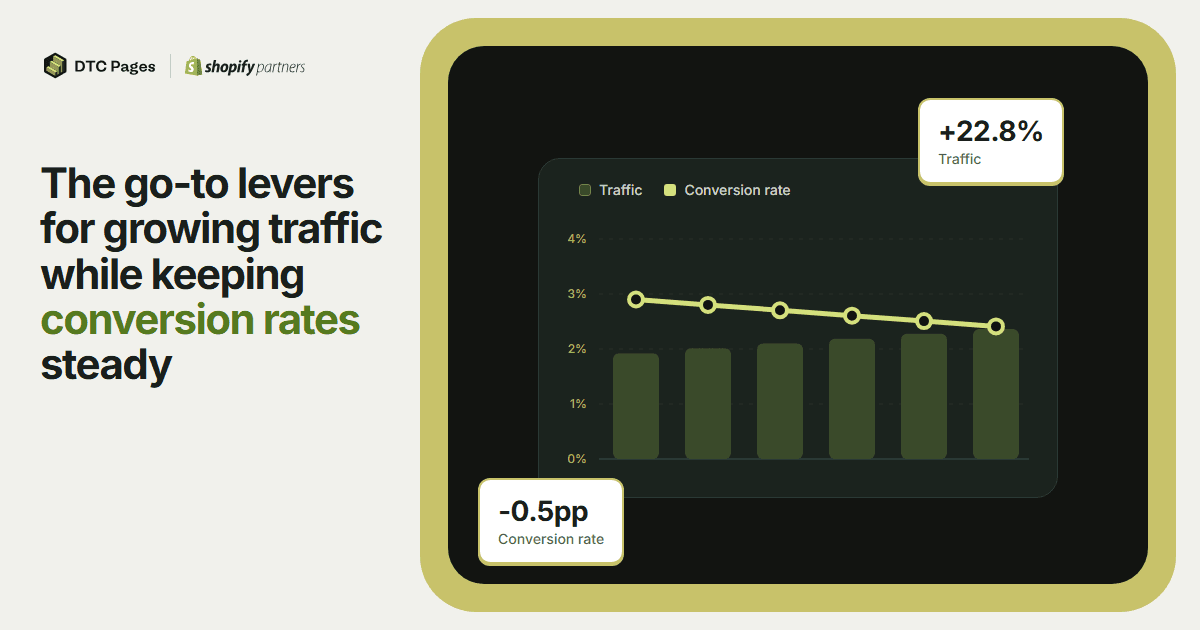
Looking back almost three years now, it seems that the logical conclusion is that we were able to maintain quality of UI/UX over this whole time, but if we look closer at data, we might get a different perspective. Across 18 Shopify stores DTC Pages works with, traffic grew 22.8% from Q1 2025 to Q1 2026, while conversion rate fell from 2.90% to 2.41%, a slight 0.5pp drop as the new traffic came in. Optimizing your website for such audiences, old and new, is the single best medicine against that dive.
I’m talking Landing pages, A/B tests, revamped PDPs, homepages. Also checkout upsells, trust badges, free gifts, rewards.
There is no one-size-fits-all recipe to keeping all KPIs balanced and aligned as you grow your online business, but these levers I just mentioned might be your best chance at doing that while protecting margins and the bottom line.
Think of a customer who already knows your brand. Why would they buy a 2nd or a 3rd time from your website if Amazon provides almost unfair advantages such as free-express shipping, better prices and a basket that does not require 5 products of your brand just to get your product to their door without paying for shipping. And remember, these 5 products usually are: one they love, 2 they like and 3 they have serious doubts about.
Yes, I know. They’ll buy through Amazon eventually, and if you play this one game right, it will add to your profits, or even at least to a better COGS due to volume increase.
Hence, enter CRM and loyalty initiatives. Remarketing on Meta and Google ads. All of that to take them back to your website, buy directly from you again (and accept cookies) so you can profit a bit better and keep them engaged in your relationship cycle.
Seems like a solid plan, right? Not quite. On average, only 2.3 from each 100 customers who will land on your website will actually convert. Read that backwards, and you realize that out of 1 THOUSAND people you invested time and money in to take to your website, 977 (and then some) are not buying from you! It is like fishing for sardines with a bluefin tuna net!
At this point you might be thinking: “Yes, I feel that. But how do I tighten my fishnet to catch more fish at each toss?” The answer is already laid out above. But I’ll get a bit more into each. Bear with me:
Landing pages#
Instagram now has 3 billion monthly users, joining Facebook and WhatsApp in the 3-billion club. Brands, services and products are being presented to us among each 3 or 4 posts by friends or meme pages. Scrolling up and down has become so ingrained in human nature that babies will try to scroll up and down your watch while you hold them, and if it is a vintage one, they might cry because the screen is not moving. And, from that social phenomenon, YOU want to hook your clientele with the coolest UGC carousel ad. Only to take them to a website full of text paragraphs, ingredient lists, and lengthy attributes that do not deliver any value to them. No, I know you don’t do that. Right? You want to keep them on their feed-like experience, so that clicking the buy button is as intuitive as liking their best friend’s outfit of the day.
This is the job of a landing page: to reduce as much friction, noise and distractions from a user from the moment they arrive until the moment they check out. To make the purchase the next, obvious, inevitable step. Because you have what they need, and you present your offer to them in a way that makes so much sense to them that they’d feel bad to say no to. Long story short: deliver only the info that specific customer segment needs, in a way they will understand it so clearly that they will make a purchase decision right on the spot. And add another order to your Shopify admin notifications.
A/B tests#
Allow me to use a comparison from my old days at the retail real estate market for this one… Say you have a clothing brand with a brick&mortar store, and you sell purple hoodies to some customers who you already know, and others you have never seen before. The first ones may have let you in on what they value most on your brand: the comfort and the style. But you are also VERY confident that presenting them the argument that your hoodies are 2x more durable and flexible than the competition might make them buy more, or pay a higher price for them.
At the same time, you know your average customer is always in a hurry when they come by the store, and most of your clientele won’t have the time or patience to hear you pitch them on both benefits.
How do you present that new, killer argument to new customers, without risking losing sales by not presenting the already best-selling benefits? You test that pitch on a small, randomized sample of your walk-in potential customers, and see if you can lift the number of buyers from 3 to 5 or 6, out of each 10. If it works, then you increase the sample, test again, until you find the perfect pitch to convert each audience best. That, my friend, is an A/B test.
Product pages#
You, a brand of scent-rich skincare rituals, have now had your 2nd best selling product in a signature-fragrance perfume (the same from the skincare line), and you have had only that one in 2 years because fragrance is just not your core. But velocity on the fragrance market is impossible to ignore, the market is pointing into that direction, and you decide to launch 2 new fragrances to form a fragrance family. What do you do? Landing pages and A/B tests, right? No… I mean, those too!
But that would only serve:
a) new potential customers who have somehow heard of the launches; or
b) your existing client base, that heard about them from an ad (you paid for them a 2nd time, sorry) or your newsletter.
What if customers in your best customer cohort just don’t care for any of that, but are still loyal to that signature-fragrance of yours they absolutely love, and have its PDP saved in their browser favorites? How do you tell them about the new fragrances?
A) a blinking, fluorescent pop-up that does not allow them to buy the product they came for;
B) a well contextualized and positioned headline just below the buy button, saying “discover your new favorite fragrance”, followed by a carousel with both new fragrances you KNOW they’ll love, and an image that shows them, on hover, what each fragrance smells like from a rich image.
You know the answer. As you also know that different moments on the customer lifetime require novelty, even more so when they are accustomed to seeing everything at the same place. Or even if they never came to your website before, and must find every information on their own. That is the job of a well-built PDP.
Homepages#
So far we’ve covered the scrollers, the rushed buyers, and the loyals. Missing anyone? The independent friends! Allow me to do a metaphor here: these are people you’ve known for some time, have engaged with you in some sense, but never converted. And you have finally invited them over, but you got stuck in traffic and they arrived earlier than you.
Think of the last time you’ve been to the place of someone you know, without them being there. How hard was it for you to find a blanket, a coffee filter or a jar of butter? You definitely did not look for the first at the fridge, nor for the latter at the bathroom sink, right? I hope you did find what you needed!
But when it comes to your online store, you mustn’t HOPE for your audience to find everything they are looking for. You MUST make their life absolutely easy, no-brainer grade.
And that’s where a pristine homepage comes in handy. Menus that deliver the most searched options, quizzes that guide the undecided ones through a personalized recommendation (with a convincing buy button that adds all of it to the cart with a special offer😉). A best sellers carousel, some trustworthy social proof that shows them real people bought it and it’s safe for them too. FAQs to break their objections, clear, intuitive navigation options, and the list goes on.
As an online store owner, you must be the person who LOVES to have visitors and welcome them to your home, while being prepared for them to arrive before you do. The homepage is your living room with an open-space kitchen, or even better: a LOFT. Your guests must be able to make themselves at home, enter every room and find whatever they need. And even toast you with a drink when you’re back. Or a purchase.
Wrapping up#
There’s a lot we could cover on other fronts, but that will be the topic for another time.
Wrapping this up: yes, you should, and must, bring more and more people to your website, and have them not buy (or buy). But with the right intention and discipline, that does not mean your conversion rates should tank. YOU should level-up your game to keep them converting.
Too hard to do it on your own? Talk to DTC Pages. I’m sure the team will be one of the best additions you do to your growth stack!
Lucas Santos Guimarães runs a DTC brand on Shopify and collaborates with DTC Pages.
Ready to grow your Shopify store?
We help Shopify brands increase revenue through A/B testing, landing pages, and conversion rate optimization. No contracts, just results.